

What Is The Surgical Repair Of An Artery Called
What is an Angioplasty Procedure?
Angio pregnant this is related to the blood vessels. Plasty refers to a surgical process to repair or restore an area. Angioplasty is a procedure to restore claret catamenia to the arteries using a special catheter with a balloon that can inflate or open blockages in the artery. The vascular dr. tin can place an arterial stent or a tube inserted to help restore proper blood menses.
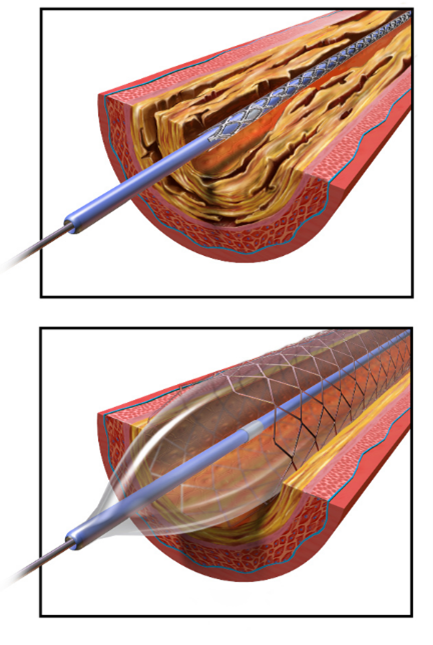
Photo attribution: BruceBlaus / CC Past-SA
What to expect?
Preoperative Clinical instructions
Detailed history needs to be obtained:
- Previous malignant disease
- Previous surgical history including history of venous catheterization or trauma
- Previous history of radiation
- Family unit history of venous disease
Careful concrete examination is mandatory
- Pulses in the affected extremity
- Diameter discrepancy between affected/unaffected extremity
- Ulcerations or pare changes
- Various examinations to dominion out any other possible vascular conditions.
What to expect during this process?
This is a minimally invasive outpatient procedure requiring no hospital stay with a short recovery menstruum. Virtually procedures permit patients to render to normal action inside a few days.
Medicine will be administered through an Four to proceed you lot comfortable but awake. A local coldhearted is usually given in the groin expanse where a needle will be inserted. The catheter is threaded through this needle. You lot volition experience pain when the needle breaks the skin, but the passage of the catheter through the blood vessel is painless.
During the Angiogram procedure, you will be asked to stay all the same and non move so that the images that are taken volition be articulate.
The dye allows the doctor to view your arteries on an Ten-ray monitor. A device with a small balloon on its tip is then inserted through an artery in your leg or arm and threaded through the arteries until information technology reaches the desired area. The balloon is inflated to flatten the plaque against the wall of the artery, opening the avenue and restoring blood flow. And so the balloon is deflated and removed from your torso.
Lower level anesthesia: Patients receive minimal anesthesia delivery under constant monitoring.
Postoperative instructions
Refrain from any heavy lifting (i.eastward. no more than than 10 pounds), straining, pushing, or impact exercises (i.east. running, jogging, cycling) for the first 3 days. You may walk, climb steps and fifty-fifty drive, then long as you do not accept excessive bruising, swelling, or pain at the puncture site.
You will be discharged with a dressing over the puncture site. This may be removed the next morning. Please audit the puncture site daily for the offset few days and notify us of any significant changes. Bruising around the surface area may be present. If you notice bleeding, swelling, or an increase in bruising apply constant straight pressure over the expanse and seek medical attention IMMEDIATELY.
Refrain from soaking in a bathtub or hot-tub or pool until puncture is healed.
Benefits of Angioplasty with CVM
A minimally invasive process that requires no infirmary stay with a short recovery period. This means most procedures allow patients to return to normal activity inside a few days. Other benefits include:
- Smaller incisions
- Less pain
- Minimal to no scars
- Less blood loss
- Lower rate of complications
Risks of Endovascular Procedures
Every process entails a certain level of take a chance. The advent of new technology and the experience of vascular doctors help minimize take chances. Here is a list of possible risk factors that may ascend.
Catheter-Related Risks
Any procedure that involves the placement of a catheter inside a blood vessel carries sure risks. These risks include harm to the claret vessel, bruising or haemorrhage at the puncture site, and infection. The chance of whatever of these events occurring is less than one per centum.
Allergy to Ten-ray Contrast Material
Patients may accept an allergic reaction to the x-ray contrast material used during endovascular procedures. These episodes range from mild itching to severe reactions that can bear upon breathing or claret pressure. Patients having procedures are advisedly monitored past a md and a nurse during the process.
X-ray exposure
Endovascular procedures are done under x-ray. Exposure levels commonly are well beneath those where adverse effects on the patient or futurity children would be a business.
Potential Adverse Effects on the Kidneys
Patients with a history of poor kidney functions are at higher risk of further damage. Blood work will exist fatigued to help identify patients at risk and levels will be monitored accordingly. Iv fluids will besides be given during and after the procedure to dilute the dye and filter the dye through the kidneys. In very rare cases additional medication may demand to be given.
Medications to avert
Outside of sure blood-thinning agents, most medications can exist connected immediately following your procedure. Medications such equally Coumadin (Warfarin) and injectable Heparin/Lovenox are stiff blood thinners that can cause delayed bleeding from teh puncture site. Nosotros unremarkably ask that these blood thinners be held for 1-ii days following the procedure, we will specify when to begin utilise of these medications.
If you accept aspirin, Plavix, or Aggrenox, you may continue the apply of these medications and then long equally there are no signs of delayed bleeding or swelling at the puncture site.
Resources
Angiogram Procedure
Atherectomy procedure
Arterial stent process

What Is The Surgical Repair Of An Artery Called,
Source: https://www.cvmus.com/vascular-procedures/angioplasty-procedure
Posted by: bowmanearthey.blogspot.com
0 Response to "What Is The Surgical Repair Of An Artery Called"
Post a Comment