

How To Install Tuner Bushings
Today I'm going to show you how to build your own electric guitar, in just a single day. The best part? It doesn't thing if you:
- Have never fabricated an electric guitar before
- Accept zero woodworking skills
- Don't ain a vast assortment of tools (you can get abroad with just a set of screwdrivers, clamp, and glue (if your guitar is a set neck) a set up of pliers, and information technology's handy to have a soldering atomic number 26 and solder.
In the case study below, I'll walk yous through the entire process, step by stride including the 'quick and dirty guitar setup' that I guarantee will make your guitar play and sound improve than 99% of kit guitars out there today.
Recommended: DIY Guitar Kit How-To Instructions
But don't kit guitars sound and play badly?
Y'all've probably heard that DIY kit guitars play badly and audio even worse. Just check out some reviews for kit guitars on Amazon and you will see what I mean. Now in some cases, the complaints are valid, some kit guitars only aren't made all that well but for the most function, the reason 99% of electrical guitar kit builds don't plow out not bad is the associates and final setup.
And that totally makes sense when you recollect well-nigh it, after all, if you were buying an 'off the shelf' electric guitar information technology will accept been professionally ready up to some extent e.yard. the intonation is right and the neck will (in most cases) be fairly straight.
And then why do the bulk of people who build their first kit guitar await afterwards it'south assembled that it will magically play and audio great without setting the guitar upward correctly? Information technology'due south crazy when you stop and remember about it.
In the case study beneath I'll walk you through the assembly of an EXP guitar kit, which turned out great, in fact, I volition have no hesitation playing it with my band. If you are contemplating your starting time build the EXP is a great guitar to showtime on equally the assembly is quick and can exist completed in under a solar day including the final setup. But don't sweat information technology if you are putting together a different model, the basics are very much the aforementioned and this case study will be of benefit to you regardless.
Commencement just a couple of quick points
This article doesn't encompass guitar finishing (or painting/staining if you are unfamiliar with the term). In nearly all cases, the finishing would be completed before the assembly. For now, we have plenty of resources on the site to go on you out of trouble.
Secondly, if you have a set cervix guitar y'all are going to need to allow at least 24 hours for the glue to dry out earlier you can get underway.
Lastly, you volition plain require an electric kit guitar, if yous don't accept a kit guitar, we take most body shapes available here.
Ok, with that out of the way let'southward interruption downwards the unabridged procedure step by step.
Assembling the DIY Guitar
Of course, before nosotros set the guitar upward were going to need to assemble the guitar correctly. Fortunately, this is all fairly straightforward and follows the steps beneath:
- Unbox, make sure all parts are included.
- Attach the neck (glue and clamp if set neck, screw tight if bolt-on cervix)
- Assemble the tuners, strap holder, string guides
- Assemble the span
- Assemble the electronics
- Setup
Equally mentioned the unabridged assembly procedure is straightforward, the only drawback for the inexperienced is the electronics (pickups, volume and tone pots, input jack and pickup selector switch).
So if you lot take never used a soldering fe earlier be certain to lodge a kit that is pre-soldered. Alternatively, be prepared to learn some nuts nearly guitar electronics and soldering.
Required Parts and Components
I've provided a separate resource for the parts and components you lot can await to receive based on the particular model guitar kit you have you take.
If your guitar is not listed below, don't fret it :) chances are it'due south a hybrid of ii of the models below.
Guitar Kit Parts and Components
LP style Guitar Kit
- Shaped and routed guitar body
- Guitar Neck (Bolt-on or Ready cervix)
- Strap buttons with screws
- 2 X Humbucking Pickups
- 2 10 Volume + ii X tone Control Pots
- 3-Way Pickup Selector switch
- Input Jack
- Pickguard and screws for mounting
- six 10 tuning pegs (machine heads)
- Melody-O-Matic bridge
- Guitar Nut
ST Guitar Kit
- Shaped and routed guitar body
- Guitar neck and screws (Commodities-on or Prepare Neck)
- Tremolo bar and springs
- Strap buttons with screws
- 3 X Unmarried-coil pickups
- 1 Ten Book + two 10 tone control pots
- 5-way pickup selector switch
- Input jack
- Pickguard and screws for mounting
- six 10 tuning pegs
- Tremolo bridge
- Nut
- Truss Rod Cover
- Cervix Plate
- Backplate cover
TE Guitar Kit
- Shaped and routed guitar body
- Guitar cervix and screws (Bolt-on or fix neck)
- Strap buttons with screws
- 2 X single-coil pickups
- i Ten volume + one 10 tone command pots
- 3-way pickup selector switch
- Input jack
- Pickguard and screws for mounting
- six X tuning pegs (machine heads)
- Telecaster Bridge
- Nut
SG fashion Guitar Kit
- Shaped and routed guitar torso
- Guitar Neck (Bolt-on or fix neck)
- Strap buttons with screws
- 2 Ten humbucking pickups
- ii 10 volume + 2 10 tone control pots
- 3-mode pickup selector switch
- Input jack
- Pickguard and screws for mounting
- half-dozen X tuning pegs (car heads)
- Melody-O-Matic bridge
- Nut
EXP way Guitar Kit
- Shaped and routed guitar torso
- Guitar Neck (Bolt-on or set up neck)
- Strap buttons with screws
- 2 10 humbucker pickups
- 1 X book + 2 x tone control pots
- 3-mode pickup selector switch
- Input jack
- Pickguard and screws for mounting
- half-dozen x tuning pegs
- Melody-O-Matic bridge
- Nut
- Truss Rod Cover
- Neck Plate
- Backplate cover
V manner Guitar Kit
- Shaped and routed guitar torso
- Guitar Cervix (Bolt-on or set up cervix)
- Strap buttons with screws
- ii Ten humbucking pickups
- ii X volume + 2 X tone control pots
- three-style pickup selector switch
- Input jack
- Pickguard and screws for mounting
- 6 X tuning pegs (machine heads)
- Tune-O-Matic bridge
- Nut
X Guitar Kits
- Shaped and routed guitar torso
- Guitar Neck (Bolt-on or ready neck)
- Strap buttons with screws
- 3 10 humbucking pickups
- 1 X book + ane X tone control pots
- 5-mode pickup selector switch
- Input jack
- Pickguard and screws for mounting
- 6 Ten tuning pegs (machine heads)
- Locking Tremolo bridge (Floyd Rose Fashion)
- Nut
Hollow Body
- Shaped and routed guitar trunk
- Guitar Cervix (Bolt-on or set neck)
- Strap buttons with screws
- two 10 humbucking pickups
- 1 10 Volume + 1 Ten tone command pots (also sold equally 1 X volume and 1 10 tone)
- 3 way Pickup Selector switch
- Input Jack
- 6 X tuning pegs (car heads)
- Tune-O-Matic bridge
- Nut
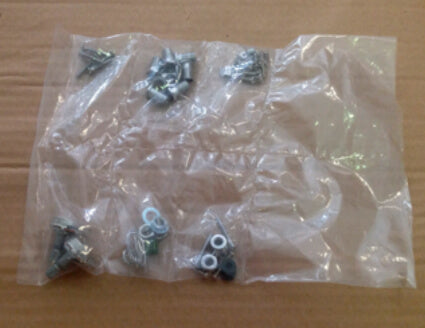
You are likewise going to notice a number of screws, springs, and plastic covers packaged along with the electronics.
In nigh cases, at that place volition exist the exact number of screws required for each component in the heat-sealed multicompartment plastic bags provided.
If yous are unsure of the size of the screw required for a specific step you can always double-check past counting how many screws are included in the section you are removing the screws from.
Fitting the Neck
For bolt-on neck guitars, this stride really is as elementary as it looks. For set-neck guitars, all the same, you will crave some woods glue and a clamp and you will too need to give some consideration to scale length.
For set-neck guitars, it's essential that you sympathise calibration length, as getting this wrong will affect your guitar's intonation (pitch accuracy) and in some cases will make the guitar more or less unplayable.
Basically, you need to ensure the length from the inside of your nut (the stop that butts up to the fretboard) to the 12th fret is half the overall length from the nut to your bridge saddles.
The diagram below demonstrates how to measure your scale length.
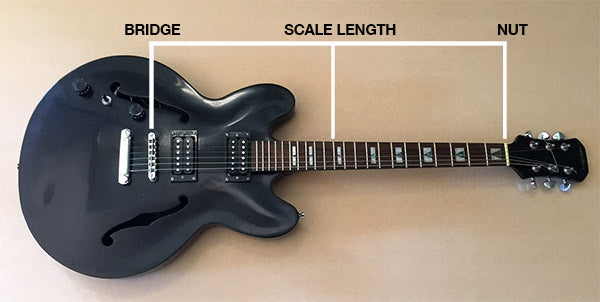
If y'all accept purchased a bolt-on neck guitar, the scale length volition have already been measured and the holes for securing the cervix volition be already in place. For a set neck guitar you will demand to check this commencement, don't only assume the neck should exist pushed in as far as information technology can go.
One time you lot accept measured the right placement of the neck, marker the position with a pb pencil on the heel of the neck and the body of the guitar then yous can line these up once again once you are ready to gear up the neck in position permanently.
Gluing the Set up Cervix
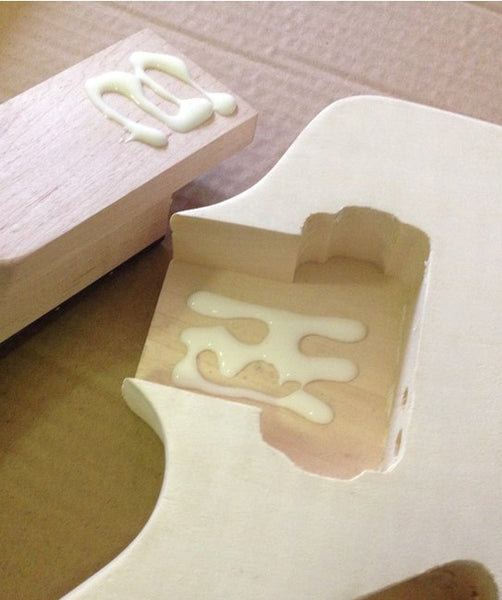
Once you have marked the correct placement of the neck information technology's time to glue the neck into position. Follow the steps beneath and be careful not to apply too much mucilage.
- Beginning, dry-fit the neck (It's always best to slide the neck into place rather than pushing/forcing it in place from the pinnacle). The neck should be a tight fit, it doesn't have to exist then tight that information technology's difficult to place in position but if it has whatsoever sideways motion it may cause a problem with the alignment of the neck itself.
- Apply a moderate amount of gum on the heel of the guitar neck and the base of the cervix cavity (eastward.g. don't use so much that is squeezes into the sides of the neck cavity).
- One time done clamp firmly (non overly tight) into place and leave overnight.
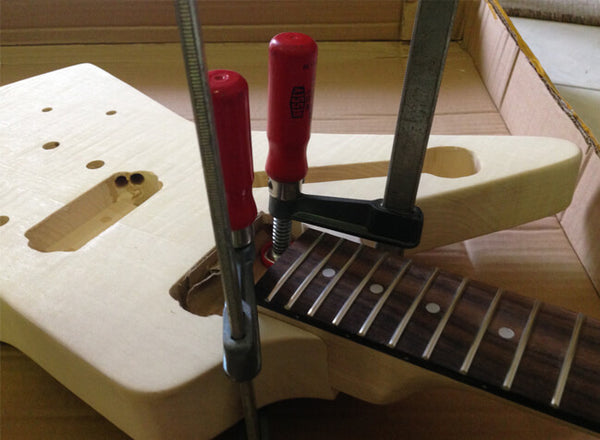
Exist certain to use a small section of carpeting or timber to protect the body and neck of the guitar, fifty-fifty if your clamp has plastic protectors. There's nothing worse than removing the clamps and finding yous have left a dent in the timber of your guitar.
Learn more than about neck assembly from our Neck Associates for Kit Guitars tutorial.
When information technology comes to glue, I generally utilise Titebond or Tarzan Grip.
Tuners
Adjacent, nosotros have the tuners, otherwise known as your car heads or tuning gears. Depending on the blazon of headstock (3 per side or 6 on peak) you volition take either 3 left and 3 correct facing tuners or 6 of the aforementioned.
The tuner assembly involves ii simple steps.
Firstly inserting the tuners themselves, so the washer and bushing. Some kit guitars will come with the tuner spiral holes predrilled. If this is the example you lot're all set. If not, it'southward however a relatively straightforward process.
Installing the Tuners:
- Insert the tuners into the pre-drilled tuner holes.
- Turn over and slide the washers over the tuners and tighten the bushings. This volition tighten the tuner sufficiently for you to correct the alignment of the tuners.
- Marshal your tuners with a steel ruler or anything with a direct edge.
- One time satisfied with the alignment use a very fine drill chip to drill the pilot holes (i/xvi inch is ideal). You will demand to pre-drill these holes, every bit the screws themselves are easily stripped.
- Once the airplane pilot holes are drilled, insert the screws and tighten by hand. (*Don't use your drill, as these very fine screws tin can be stripped hands.)
- Once in place use a set up of pliers to tighten the bushings further (existence careful not to scratch the chrome tuners) and you're done.
Strap Buttons
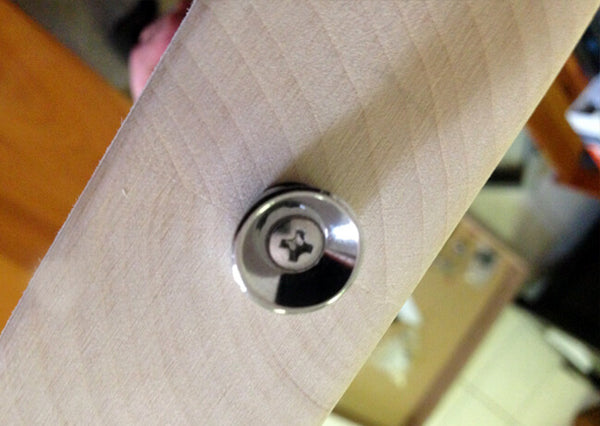
No need for lengthy explanations hither, simply measure the exact placement for your strap buttons and spiral in place at the front and back of the guitar, making sure the felt washers are in place to protect the timber.
Depending on your body timber, y'all may not need to drill pilot holes first. Generally speaking, softer timbers such as Paulownia or Basswood won't require pilot holes, while denser timbers e.g. Alder typically will.
The Bridge
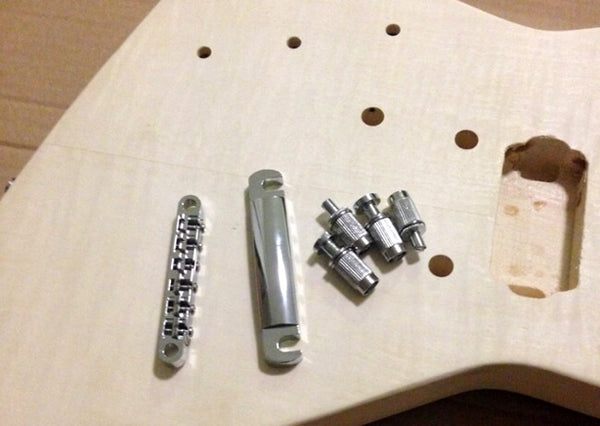
How you go nearly installing the bridge volition depend on your guitar. I've covered the differences betwixt common guitar kit bridges here. For the EXP style guitar, however, nosotros'll are be installing a Melody-o-Matic bridge.
Installing the Bridge
- Beginning, nosotros'll need the bridge and tailpiece posts. These are the adaptable posts shown in the picture to a higher place.
- To begin, push the 2 tailpiece posts into the ii rear holes provided. Please merely apply a small corporeality of pressure here. (*We will need to remove these over again when earthing the electronics, and then merely push button in place gently for now).
- Once your tailpiece posts are loosely in, repeat the process with the bridge posts, taking care to avoid them going in on whatsoever kind of angle. You can push these right in, as they won't be removed again.
- If the bridge post requires some forcefulness to insert into identify, a hammer will do the trick but brand certain the cervix is fully supported and the guitar is well padded below. Also, don't use a metallic hammer straight on the mail (employ a timber offcut) to protect it.
- It's important these go in straight. If you observe they are on an bending in any way, cease, attempt to adjust and continue on. They should be driven into full depth, which volition leave a small-scale lip on the surface of the guitar.
- Adjacent screw back in the thumbwheels. The larger face of the posts is used in the tailpiece.
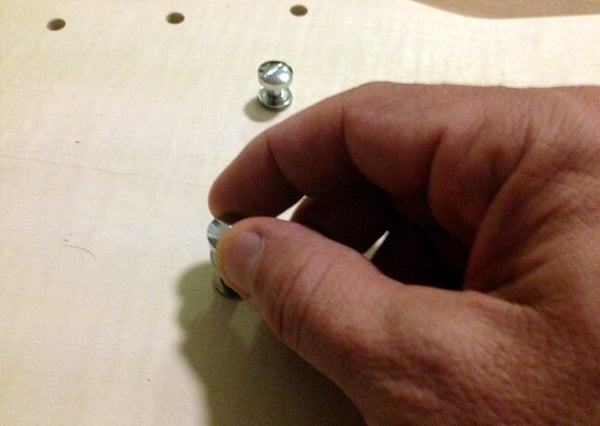
That's pretty much it for the bridge, you can position the bars to get an impression of the bridge itself simply these will then be taken off as they won't remain in place without tension from the strings.
Lastly, don't be alarmed if you notice your bridge is on an angle. This is actually done deliberately for intonation purposes. The angle compensates for the heavier approximate strings by increasing the length of the cord marginally.
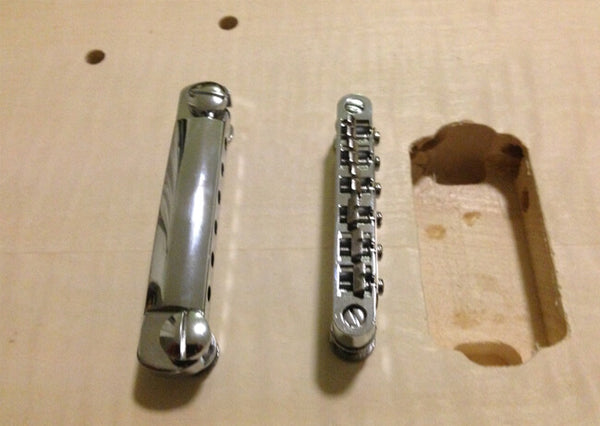
If you aren't familiar with intonation, don't sweat it we volition encompass this in more detail when setting up the guitar.
Electronics
Next, we'll go the electronics in place. This includes your pickups, volume and tone pots, output jack and pickup selector switch.
The EXP has a fairly standard setup, and is like to other models such every bit the LP, SG and a number of hollow-body guitar kits:
- 2 X humbuckers
- 3-style selector switch (span pickup, cervix pickup and combined)
- 1 X volume
- 2 Ten tone
- Input jack
If you accept a pre-soldered kit and then this step is really quite simple. If you do demand to attach your wires to the pots, selector switch and input jack there are a ton of costless wiring diagrams online and wiring and soldering tutorials online.
Getting Started
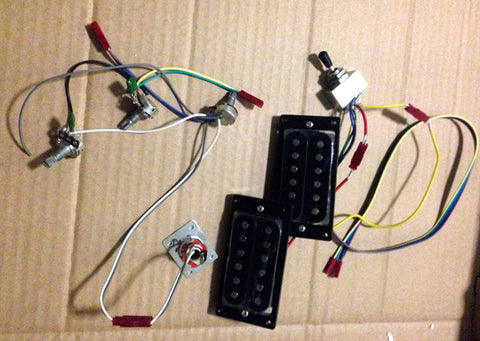
In virtually cases kit guitars generally won't require any soldering, They are oft pre-soldered to the tuning and volume pots and pickup selector switch. The pickup wires and input jack wires are and then joined one time positioned via plastic clips (These are cerise in the image higher up) fastened to the end of the color-coded wires.
The wires are color-coded and pre-soldered to make the process of installing your electronics quite simple. Nonetheless, solder joints tend to break if the wires are manipulated even a little, so it's a good idea if you don't already ain one to beg, borrow or steal yourself a soldering iron and some solder in the event a wire comes off.
I accept a few tips on soldering hither that will likewise assistance steer you lot away from any potential issues.
The order of how yous get about things is important. There's no point installing your pickups first as your wires from the pickup selector may need to travel through the same cavity. Generally speaking, it'due south advisable to start with your input jack and selector switch, followed by the pickups.
It'southward well beyond the scope of this commodity to cover the myriad of different ways to wire up the electronics of your guitar, and so we'll be sticking with the trusty EXP nosotros've been working on, permit's get started.
Installing the Input Jack and Selector Switch
- First, insert the input jack. This become's threaded through the input jack hole and positioned before screwing in place. You may need to drill pilot holes first depending on the timber your torso comprises of.
- Side by side, we'll move onto the pickup selector switch, which consists of 2 shorter wires for the pickups and 4 longer wires for the volume and tone pots (potentiometers).
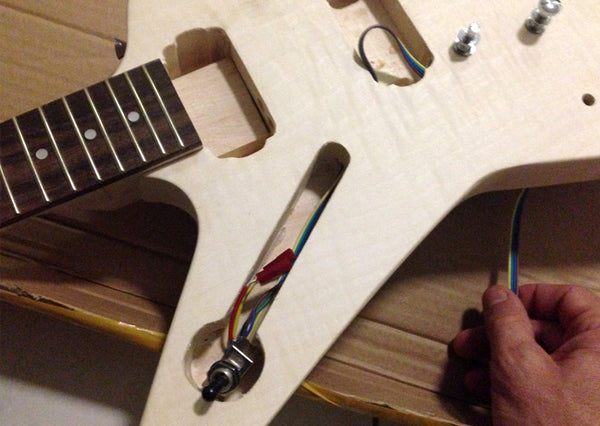
To install the pickup selector switch on the EXP just sit the switch in position as per the photo and thread the longer wires through the pre-drilled pigsty at the dorsum of the cavity through to the control box cavity on the rear of the guitar.
Installing the pickups
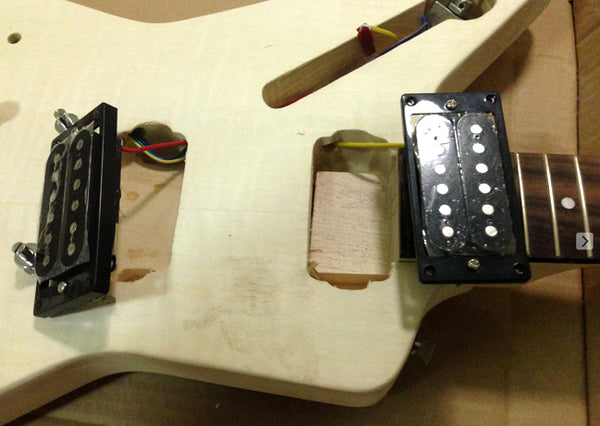
Your pickups will vary based on your guitar. If you have ordered an ST or TE fashion guitar, these will be generally be pre-mounted on your scratchplate, so the work's already washed for the most office.
If assembling a guitar with nickel covered pickups you lot volition desire to ensure the pole pieces are on opposite ends. east.grand. the front end pickup poles should be closest to the neck join, while the back pickup poles should be closest to the span.
More often than not, the pickup rings will be on an angle that makes it fairly easy to work out which mode they should face based on the contours of the guitar body, equally per the paradigm below.
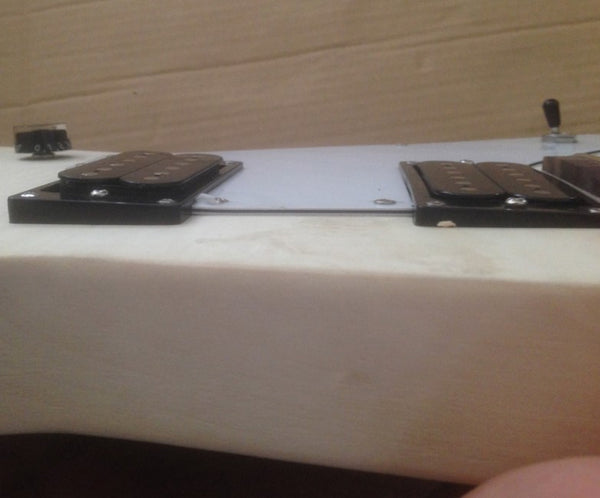
- When you start expect at the two pickups you volition see some subtle differences e.g. the pickup rings are thinner on 1 ready of pickups and they may also be angled at the bottom. The angle is generally to compensate for the natural contours of the guitar and the neck pitch, so fitting these the correct way around is pretty straightforward. The highest pickup goes to the bridge with the highest border closest to the bridge with the neck pickup facing it'southward the lowest edge against the neck.
- Once you take established the orientation of your pickups place them in the cavities provided and thread the wires through the pre-drilled holes establish at the front end (neck pickup) and side (bridge pickup).
- One time threaded connect the corresponding colored wires to the clips provided from the pickup selector switch. be certain these are correct before doing so, however, as information technology is near impossible to split up these once joined.
- Before we screw the pickups into place. There are a couple of things to keep in mind. First, yous want the pickups to be aligned, symmetry is important when it comes to assembling a nice looking guitar and lastly, we will want the scratchplate to fit well.
Pickup Alignment
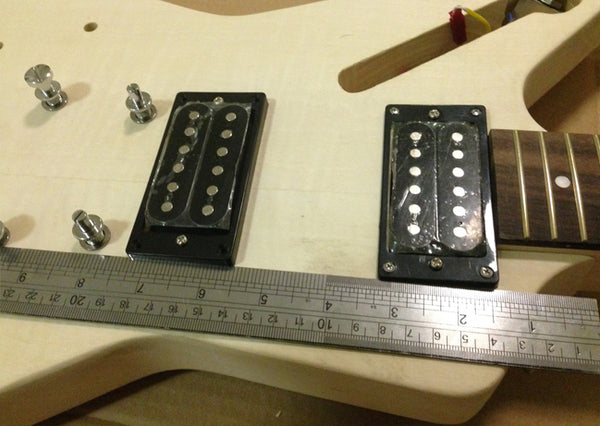
- Loosely fit the scratchplate and take a look at the positioning of the pickups. While the cavities are routed to a specific size there is room for the pickups to move around a little so you want to make certain of the position before screwing the pickups into place that the scratchplate will fit.
- In one case you are satisfied, brand a couple of small pencil marks to requite yourself an approximate idea of placement.
- Next, with the assistance of a steel ruler align the pickups every bit per the image above. The neck pickup should fit tightly against the edge of the neck on the EXP so you can fit the span pickup based on information technology's alignment to the neck pickup.
- One time satisfied screw the self-tapping screws into place, past screwing the opposite diagonal sides starting time. e.g. screw the top left in identify, bank check the alignment again and so spiral the bottom right screw into place. Once done insert the remaining screws and tighten.
Installing the Scratch Plate
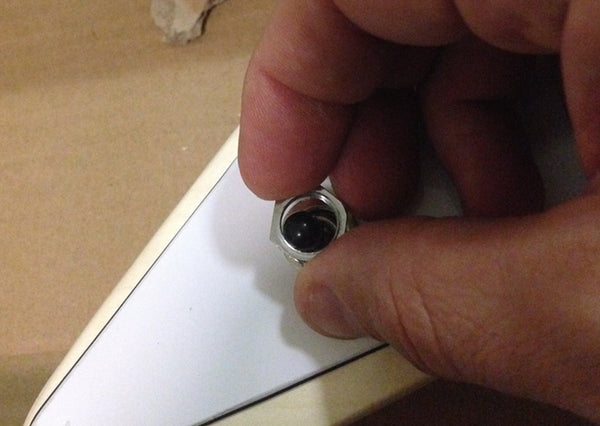
Next, we're going to install the scratchplate (pickguard), every bit this will allow us to flip the guitar over without the pickup selector falling out and running the risk of our solder joints breaking.
- First, unscrew the toggle switch nut and washer from the pickup selector.
- Position the pickup selector through the provided hole on the scratchplate
- Identify the washer and tighten the nut until it's sitting flush against the scratchplate.
- Fit the scratchplate loosely and make certain everything fits equally it should. If your pickups take moved and the scratchplate isn't plumbing fixtures you lot may demand to use a file to remove a few mm from the edge. Do this in small increments so you ensure you don't remove besides much at once.
- One time the scratchplate fits, kickoff inserting the self-tapping screws. If the timber of your guitar torso demands information technology, drill pilot holes first using a 1/16 inch drill bit.
The Control Box
Nosotros're getting close to finishing the electronics, in fact, we're close to completing the assembly of the guitar. To add the control box, first flip the guitar over, you will notice on the EXP there are three holes drilled for the book and tone pots along with a wire clip extending from the input jack.
Don't exist daunted, in the majority of cases, these are color-coded and easy to friction match upward and clip together. Let'southward get those pots in place first.
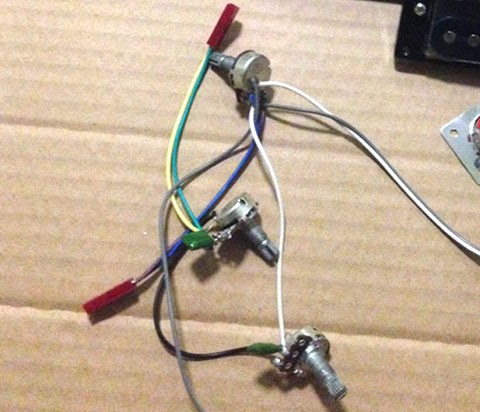
As y'all can see from the epitome to a higher place in that location are two pots with wires extending to a ceramic green summit. These are the capacitors. I won't get into also much detail about these in this commodity, suffice to say the role of the capacitor is to remove loftier frequencies earlier they become to the input jack and ultimately your amp. Every bit a result, the capacitors are found on the tone pots, leaving the pot without a capacitor as the volume.
I generally apply the get-go pre-drilled hole for the volume only you lot can put these in any lodge you see fit.
You volition also meet a loose gray (sometimes blue) wire with i end non continued to annihilation. This is used to world out the signal, we'll embrace this in more than detail in a infinitesimal.
Installing the Pots
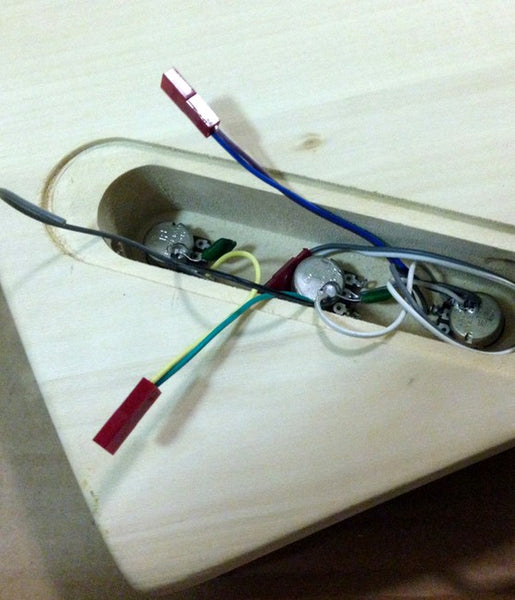
- Begin past threading the first pot into the first pre-drilled hole. Exist careful to ensure there are no wires beneath the pot as this will stop it sitting flush against the timber and arrive difficult to fit the washer and screw. Once in place, insert the side by side two pots making sure they as well sit flush against the timber.
- Once your pots are in position, sit the guitar on its side and maintain some pressure on the pots and then they don't fall out.
- Side by side, grab the 3 washers and basics provided and outset add together the washer and then add the nut and tighten the pot against the guitar torso.
- Do this for all three pots and then flip the guitar back over with the command box cavity facing upwardly.
- Lastly, connect the wires to their corresponding colors.
Earthing The Guitar
Earthing the guitar is pretty simple, we but need to thread the loose gray wire (this volition occasionally be bluish) through the small hole drilled into the lesser inward-facing side of the control box crenel.
The bones idea is to position the earth wire to sit against the tailpiece bushing, which will ground/earth out the signal to reduce backlog noise. To do this involves removing the tailpiece mail that we but loosely pushed into place when installing the bridge.
Installing the Earth Wire
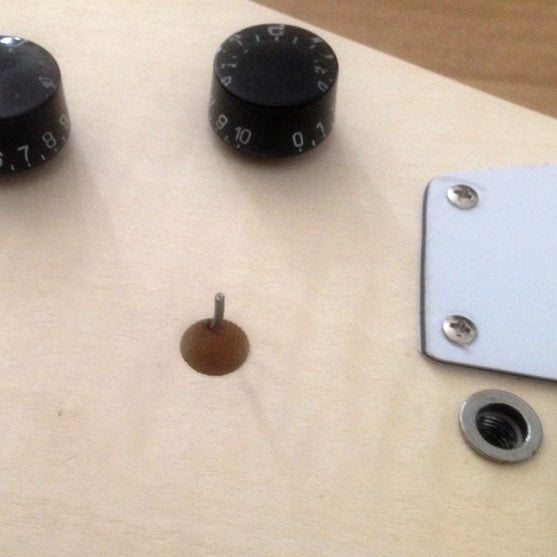
- First, flip the guitar and remove the corresponding tailpiece bushing. Then simply push the wire through the pigsty until it appears through the tailpiece pole sleeve. A give-and-take of alert, this can be tricky, patience is primal, there'south no existent trick to it.
- Side by side, strip some of the plastic casing away to reveal the naked wires.
- To finish we then add the tailpiece bushing keeping the naked wires from the globe wire against the side of the span pole pigsty, ensuring it volition be in contact with the metal tailpiece bushing, allowing the indicate to earth out. Every bit mentioned in the bridge assembly section, brand sure these become in directly.
- Once done screw the plastic embrace on the back of the command box and the electronics are complete.
And that's basically it, you have assembled an electric guitar. But that'southward not the end of things, we however accept our concluding setup to complete and strings to put on. Let'due south dive straight into the 'Quick and Dirty Guitar Setup' shall we?
I recommend that y'all don't skip this role, it's probably the most of import part of the article! This is the difference between a kit that looks ok simply y'all don't enjoy playing that much, to a guitar, yous accept with y'all and proudly say 'I made it myself' when someone asks yous what kind of guitar is that?
The Quick and Dirty Guitar Setup
Offset things first, this method can be used for all electric guitars, not just kit guitars you accept just assembled. Then be certain to utilise this technique to all your electric guitars. I guarantee they will play and sound better than they practice now if they haven't had a setup for a while.
There are no groundbreaking methods included here, information technology'south just an effective step by pace method to cease your guitar that really nails it for anyone who hasn't washed a setup earlier.
The setup covers 5 major steps in the following order:
- Strings
- The Neck
- Activity
- Intonation
- Pickup Height
Why prepare upwards your own guitar?
I get it, but hither'southward the matter...it's really not that difficult to set your guitar upwards properly, it'south just a matter of learning the steps required.
Sure, it makes sense if you are a professional musician to take the guitar in for a pro setup, the guys that practise this day in, day out have a lot more experience not to mention specialised tools but if you want to save your difficult earned cash and learn something new at the same time then learning how to set up upward your guitar is invaluable.
Changing the Strings
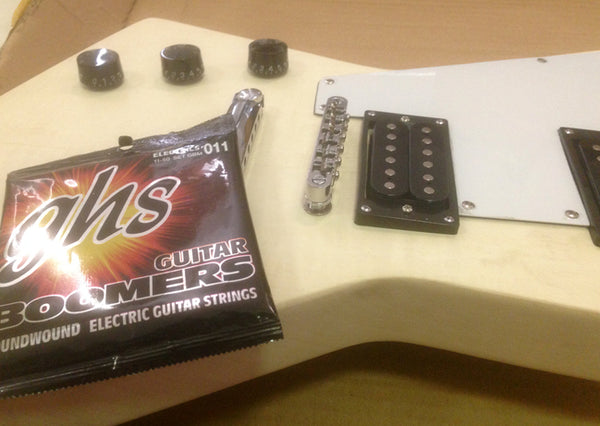
First, you are going to desire to change your strings. Most kit guitar suppliers provide strings with their kits but the strings themselves are, for lack of the better word "basic" and actually only serve the purpose of providing you something to use until you go a fix of your regular, tried and true strings.
Anytime you perform a gear up information technology'southward new string time, so beat out out the $fifteen and take hold of a set.
Non sure what strings to attempt?
I recommend Ernie Brawl Slinky's or GHS Boomers, go for a calorie-free gauge to offset with e.g. .10's to .46 until you lot have played enough to develop a preference.
Stringing your Guitar
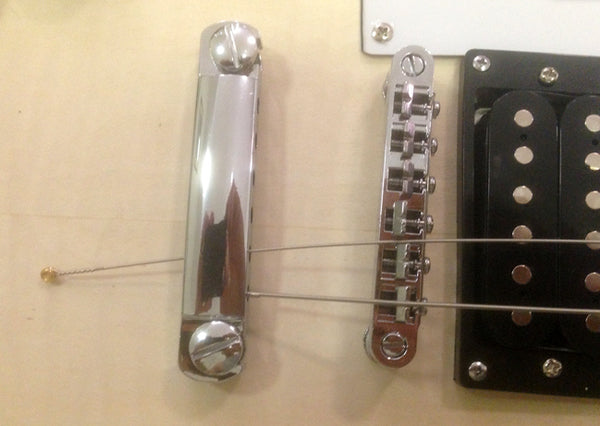
- Screw the thumbwheel on the bridge all the way down.
- Add together the six strings, pushing the strings through the Tune-o-Matic span tailpiece holes.
- Snip the strings using a pair of wire cutters.
- Lastly, give the strings a good stretch. Melody them to concert pitch and give them another skillful stretch. Repeat the process 3-4 times to ensure your strings remain in tune when played.
Straightening The Neck
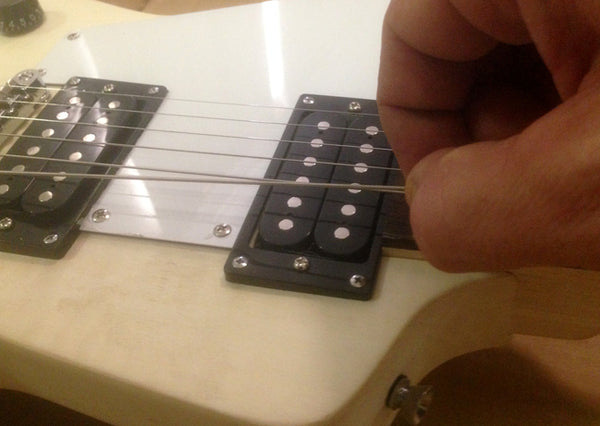
Adjacent, we're going to make certain the neck is straight...well in a sense at least. You see, a dead straight neck isn't ideal when it comes to electric guitars. What we demand is a slight (very slight) cervix relief (inward bowing cervix).
Nosotros do this to reduce the risk of fret fizz. Basically by creating some relief between the first and terminal fret the string can vibrate freely without buzzing against whatever of your frets.
The amount of relief is really up to yous, but too much tin can have an issue on your activity, specially from around the fifth to 14th fret, while besides piddling and y'all will take issues with fret buzz.
Setting a Slight Neck Relief
To practise this we're going to need to adjust the truss rod. (We oasis't added the truss rod cover yet and so the truss rod is easily accessible). Your kit guitar will take come with an alum or hex key specifically designed for the truss road and then firstly locate the alum key and make sure information technology fits. The truss rod is a straight steel bar going through the neck itself, that when tightened (bows the cervix outward) or when loosened bends inwards.
Before nosotros make any adjustments though, we're going to need to cheque how straight the neck is.
Adjusting the Truss Rod
The truss rod is plant on the headstock of your guitar, for near guitars anyhow. There are guitars that have the truss rod at the opposite end of the neck merely the EXP's truss road is located as per the motion-picture show beneath.
The EXP had an almost expressionless direct neck so I set almost adjusting ever so slightly until the cervix had a slight relief. This simply took 3/4 of a clockwise turn.
When adjusting your truss rod, think to only turn in small-scale increments at a time and proceed to check at regular intervals.
Setting your Guitar Kit's Action
Your guitar's action is the distance between your guitar strings and the fretboard.
For many guitarists, a lower action makes the guitar easier to play. The notes require less down pressure to be fretted which in plow allows for greater speed effectually the neck. However, if the action is too depression you lot will also run into bug with fret buzz.
Your platonic action is basically whatever is all-time suited to your playing. A lower action as mentioned in a higher place has advantages when it comes to playing faster, however, the trade-off can be your guitar's sustain which is thought to improve with a higher action. If yous're a slide histrion you volition definitely prefer a higher action, so take into account your way of playing offset.
How to Set Your Guitar'due south Action
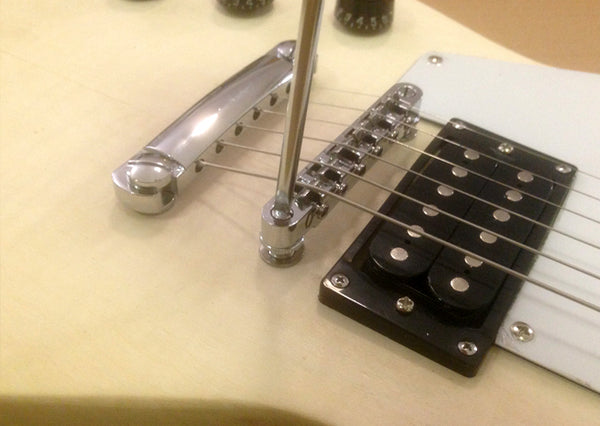
For the EXP this is pretty straightforward. Using a flat-tip screwdriver, turn the bridge posts clockwise to lower the action or counter clockwise to raise the action.
For the tailpiece posts, at that place's really no point in having these anywhere except fully screwed downwardly. You may observe your sustain improves too.
Only increase the peak if the angle from the span to the tailpiece is quite sharp as you may start breaking strings.
Fretboard Radius
Fretboard radius refers to the curvature of the fretboard. This should not be confused with the neck profile. Cervix profile refers to the radius of the cervix and non the fretboard.
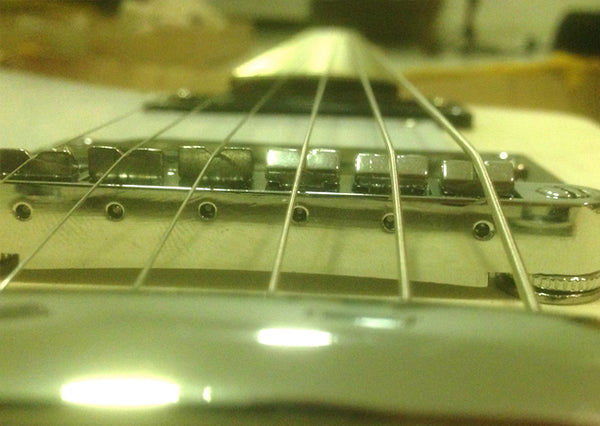
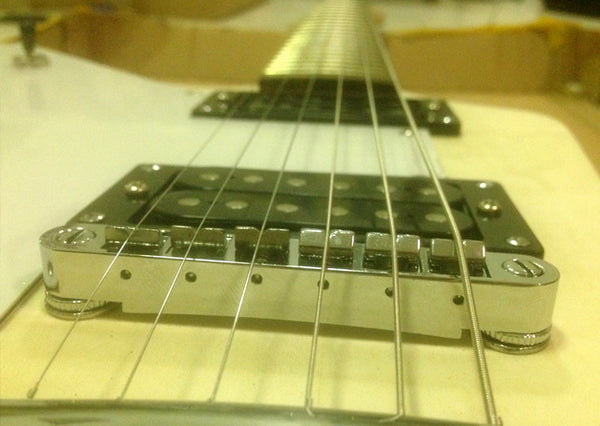
Equally you can meet in the picture in a higher place, the fretboard of your guitar has a gentle curve. The saddles on your bridge match this curve.
Every bit the EXP uses a Tune-o-Matic bridge, this isn't a problem as the saddles are not adjusted individually. However, on other models such every bit the ST or TE the saddles are adjusted individually and the fretboard radius should be kept in mind.
Intonation
Now we need to check the guitar is in melody with itself. Intonation is the pitch accurateness of the guitar, if the intonation is off, your playing sounds off so it's an important part of the setup procedure.
To cheque your guitar's intonation first melody the guitar and so cheque the tuning of each individual string at the twelfth fret harmonic. Existence a full octave information technology should be the exact same pitch equally the open cord. If however, it is sharp or flat your intonation is off and needs to exist adjusted.
To adjust the intonation if the 12th fret harmonic is precipitous we need to lengthen the string, if on the other hand, it is flat we would need to shorten the string. The cord length is adjusted at the saddle for each private string.
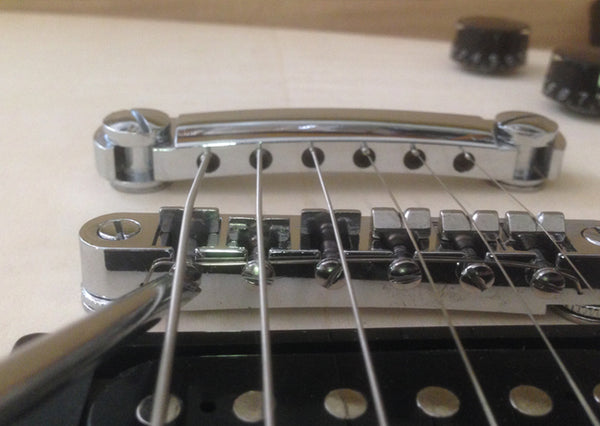
How to adjust Your Intonation
- Using a apartment tip screwdriver turn the saddle spiral clockwise to shorten the cord and counterclockwise to increment the length of the string.
- Just turn the adjustment spiral a half turn before checking the intonation again
- If yous take turned the adjustment screw equally far as information technology volition get, you lot may need to check your neck relief as this will as well shorten the length of your strings.
- Repeat for all half-dozen strings
Pickup Tiptop
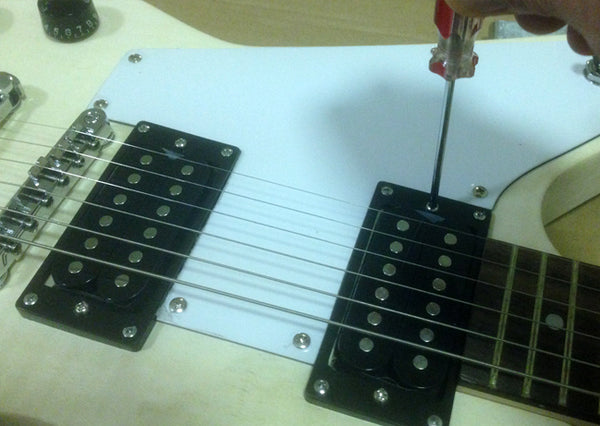
Finally, we come to pickup meridian. This is another important component of your guitar's overall tone and needs to be considered advisedly. Before nosotros go besides far down the path, it's probably a expert fourth dimension to mention that the bulk of kit guitars come with entry-level generic pickups. That'due south not to say they sound half bad, just it's often the first identify someone volition upgrade their electric guitar.
All the same, getting the ideal pickup summit of your electric guitar can make a large deviation to your guitar'due south overall tone. I've already covered why this is of import in another article so for the sake of keeping things moving forth, nosotros'll get into the meat of things early.
- Plug in your guitar at medium/loftier volume (At that place's no bespeak testing at a lower volume than yous play at) and use the same tone settings on the guitar as yous do normally.
- The EXP has two humbuckers so the pickups should sit relatively apartment, but if adjusting single coil pickup it's best to make the bass side of the pickup a trivial lower than the treble side.
- Adjust the height of the pickups by turning the adjustment screws. Generally speaking, humbuckers can get every bit high as you similar without getting too noisy merely single coils should be adjusted based on the amount of noise you are hearing.
You will typically find a flake of a sweetness spot, merely information technology'southward pretty piece of cake to lose objectivity when y'all are testing these things so if you start struggling to hear a difference information technology might be time to requite it away and come back later with a fresh set of ears.
Summing things up
And that's it.Y'all are done. Guitar assembled, terminal setup complete. Of course, as mentioned early on, this guitar would commonly have been painted showtime, but that's the subject of our next case written report.
If you're interested in learning more nigh guitar finishing check out articles below:
- Guitar Finishing 101
- Guitar Finishing Safety
- Sanding a Guitar Body Prior to Painting
- How to Utilize a Sunburst Guitar Finish

Source: https://guitarkitworld.com/blogs/resources/assemble-electric-guitar-kit
Posted by: bowmanearthey.blogspot.com
0 Response to "How To Install Tuner Bushings"
Post a Comment